|
|
| |
| |
|
|
|
|
|
|
|
|
|
|
|
|
|
|
|
|
|
|
|
|
|
|
|
| |
|
|

Total Designz/Silvercrest Computer Services
Copyright Blackwater Ocicats 2006-2014
|
|
|
| |
|
|
|
|
Ocicat Genetics |
|
| |
|
|
BEAUTY ISN'T JUST SKIN DEEP, IT GOES DOWN TO THE GENES
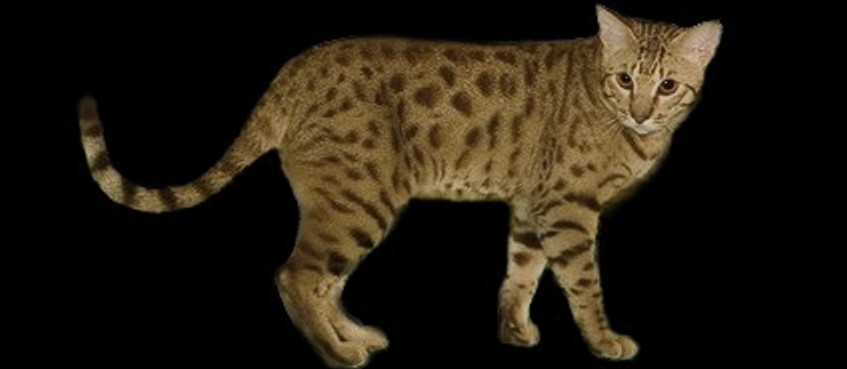
For you more advanced or curious people we will cover some Ocicat genetics. Many people comment they see "spotted" cats running loose in their neighborhood so therefore it is an Ocicat. An Ocicat is more then just a spotted cat. It is the total of the genetics of the cats who made up the breed.
Here is a link for basic genetics of cats
We will cover here just genetics of the Ocicat.
First the colors
The Black (B) pattern color was inherited from both the Aby and the Siamese, the Chocolate (b) was inherited from the Siamese and Cinnamon (bl) inherited from the Aby. The silver (I, inhibitor gene, in other words inhibits color) ground color was brought in with the American Shorthair.
From all the breeds we have probably introduced the
modifier gene (d) for dilution turning black to blue,
chocolate to lavender and cinnamon to fawn.
Here is a link for a color chart on Ocicats.
Once you have read anything on genetics you will realize that ALL cats are "tabbies".
An Ocicat is a spotted cat whose pattern follows that of a "classic" pattern. For this reason our standard carries 40 points for pattern alone.
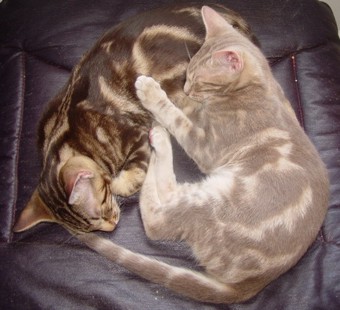
We believe the spotted pattern was inherited from the Siamese, as many Siamese in the era that produced the first Ocicat showed a spotted pattern on their torsos especially as they aged and darkened. We also now believe that the spots are modifying a pattern. Therefore it in itself is not a separate PATTERN, it just modifies genetically whatever pattern the cat carries. In the early days Ocicats carried both classic and mackerel patterns, both of which could be modified by the spotted gene. We found that working with the mackerel pattern was hard as it produced spots in sort of a tiger pattern causing elongated spots as opposed to the more pleasing rounder thumb print shape spots. Since mackerel is dominant over classic it was easy
enough to eliminate mackerel from the gene pool by not using mackerel patterned cats to reproduce thus leaving us today with all classic patterned cats.
Because the Ocicat can still be outcrossed to Abys we still need to deal with another coat pattern and that is TICKED (T). First generation cross to an Aby will produce all offspring with ticked coats. Although the spotted modifier may still be there with a ticked coat it usually only shows as small spotting or as we call it "trout" spotting. Second generation of a spotted bred to a ticked can produce spotted but also ticked AND our none spotted variety.
Since the spotted modifier is dominant we see in litters the non spotted variety, or we just call them classic. And since the Ocicat is an "agouti" cat and that gene is also dominant we also get non-agouti or solid.
Gone but not forgotten is the Siamese gene (cs), although rare it does show itself. This produces a blue eyed pointed spotted cat which we call "ivories".
The majority of reputable breeders do their homework. We deal with color, pattern and body conformation genes when we work to produce the "perfect" Ocicat. We have to take ALL that in consideration when producing what you see today as the OCICAT.
|
|
mackerel tabby Ocicat |
|
classic tabbies |
|
|
|
|